Sárospataki Füzetek 2024/4. – Editor's foreword
The martyrdom of the early Christians was not merely sowing seeds, as Tertullian beautifully put it, but also became a powerful moral and spiritual ammunition for medieval Christianity. Despite torture and even death sentences, Christians who persevered and professed their faith set an example for Christians in later centuries. They became the first saints, whose cult was an important source of guidance and reinforcement for the Church, a "capital" that was readily referred to in the Middle Ages and later. In the darkest periods of the medieval Church, at the lowest points of ecclesiastical corruption, these models and examples were a source of strength. This example helped the monks of the following centuries to live their ascetic lifestyle, just as the examples of the founders of religious orders later kept this tradition alive. For everyday people, these life stories and legends, retold by the Church, have always served as guides. During the Reformation, the reformers sought to return to the Holy Scriptures as strictly as possible and to refocus on the Bible, thereby ridding the medieval church of many of its elements. For this reason, they sought to strip away everything that had been built up in the church during the Middle Ages and which, in their view, had wedged itself between the Word and the faithful, as if it had been superimposed on the original content. The determination of theologians to purify the central message of Christianity naturally led to the disappearance and even prohibition of the cult of Mary and the saints in Protestant circles. With the disappearance of all this, however, the stories of saints and martyrs, which had become an important part of medieval thinking and the medieval Christian ethos, also disappeared. Yet life stories and examples of how to live are important anchors for believers. To compensate for this, the Reformation paid even greater attention to the stories of the Old Testament, and perhaps this loss is also related to the fact that until the end of the 16th century, and even in the 17th century, many stories from the deuterocanonical books enjoyed great popularity in Protestant circles.
The Reformation era was marked by serious bloodshed in many parts of Europe, including France, Germany, and even England. A peculiarity of Hungarian history is that, in the shadow of the country's division into three parts, the Ottoman threat, and the trauma of the Battle of Mohács, the process of confessionalization, especially until the 1650s, was much less bloody than in other parts of Europe. The exceptional determination of the first itinerant preachers naturally gave rise to stories, in the cases of Mátyás Bíró of Dévai, Mihály Sztárai, and István Kis of Szeged, some of whom were imprisoned. Nevertheless, martyrdom was much less prevalent in the tradition of the Hungarian Reformation. The decade of mourning during the 1670s, the fate and stories of the galley preachers, made up for this. The memory of the martyrs who suffered torture and galley slavery for their faith was faithfully preserved by their congregations, who erected memorial plaques in their honor. Nevertheless, the individual stories of galley slavery did not become an integral part of Protestant memory. A significant part of our galley slave history still awaits retelling, even three and a half centuries after the events took place.
May 5, 2024, marked the 350th anniversary of the meeting of the Bratislava court, where Protestant pastors and teachers were convicted as punishment for the Wesselényi conspiracy. The process had already begun in August 1673, when György Szelepcsényi summoned only those pastors from Upper Hungary who were primarily involved in the Wesselényi conspiracy. All 33 were sentenced to death, but the sentence was eventually changed. They were given the choice of leaving the country or signing a pledge to give up their pastoral and teaching duties. Of the much larger number of Protestant ministers who were subsequently summoned, 300 appeared before the court. The government continued to view the Protestants as the main instigators of the conspiracy, even though the noblemen at the head of the organization were all Catholics. As a result, the Catholic Church and the Habsburg government decided that the time had come to accelerate the process of recatholization. Of the 300 people who appeared in Pozsony, 236 signed the pledge, while the rest were imprisoned and later sold into galley slavery in Trieste and Naples. The latter were released through the intervention of Dutch Admiral de Ruyter.
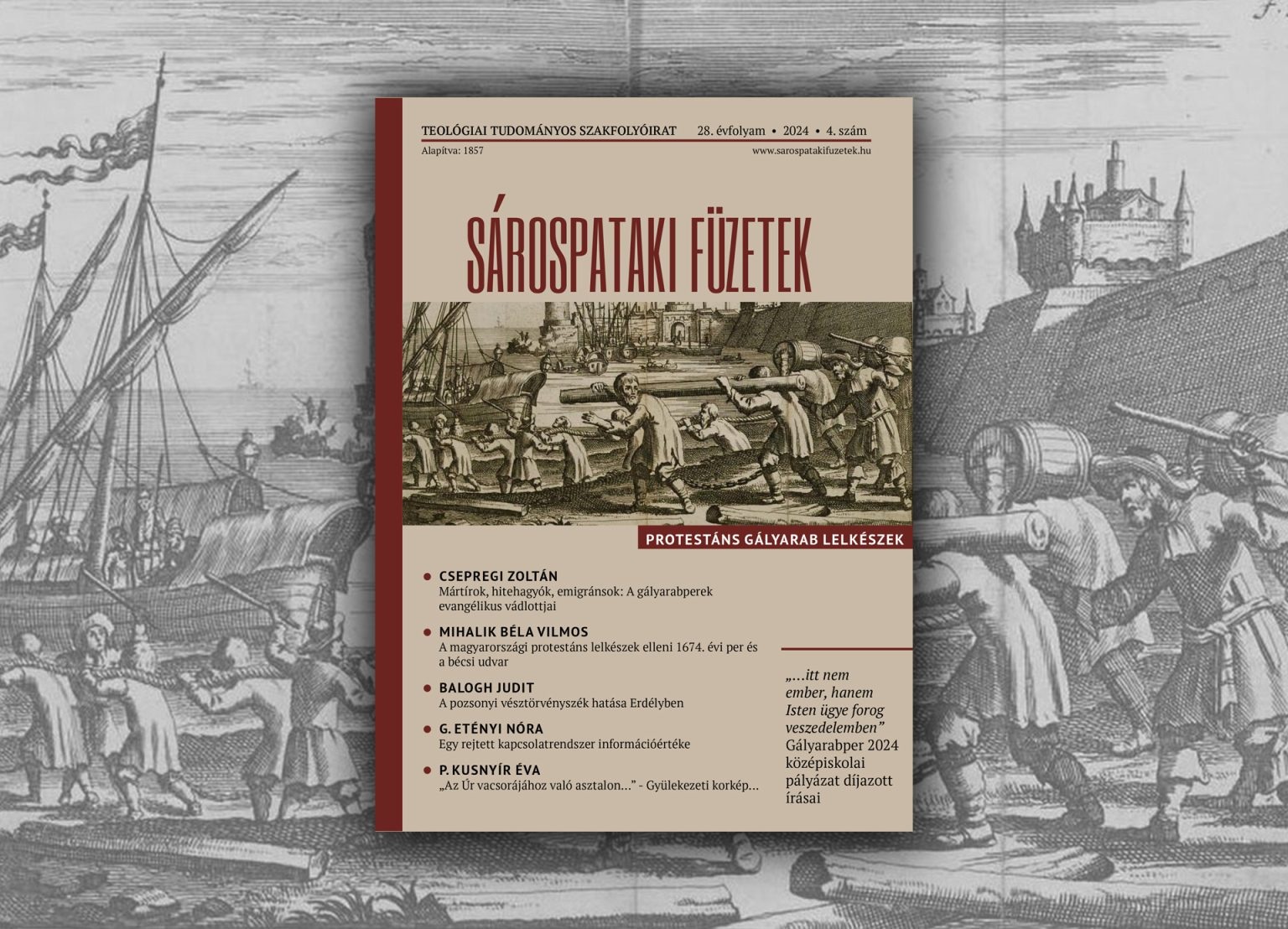
In this issue, the studies examine the galley slave heritage from several angles. Zoltán Csepregi explores the fate of Lutherans forced into exile to escape persecution, their role in exile, their career development, and those who returned home and those who remained abroad. Béla Vilmos Mihalik's previously published but slightly revised study presents the plans and events that preceded the emergency court. Judit Balogh examines the reactions and action plans of the Reformed elite of the Principality of Transylvania to the decade of mourning through an analysis of Transylvanian ego documents. In her previously published but also revised work, Nóra G. Etényi presents the news of the decade of mourning as it appeared in the international public sphere of the time, particularly in the printed political discourse of the Holy Roman Empire. Éva P. Kusnyír examines the contemporary kleinodions (altar furnishings) of congregations associated with galley slavery through the pastors involved, Anett Csilla Lovas deals with the literary appearance of the motif of galley slavery and analyzes Zsolt Harsányi's short story Karácsony a gályán (Christmas on the Galley).
With this issue and these studies, we not only wish to commemorate the events of three and a half centuries ago, but also to contribute to retelling the stories of the galley slaves and the persecuted, so that their memory may become our memory.
Judit Balogh
professional editor of this issue